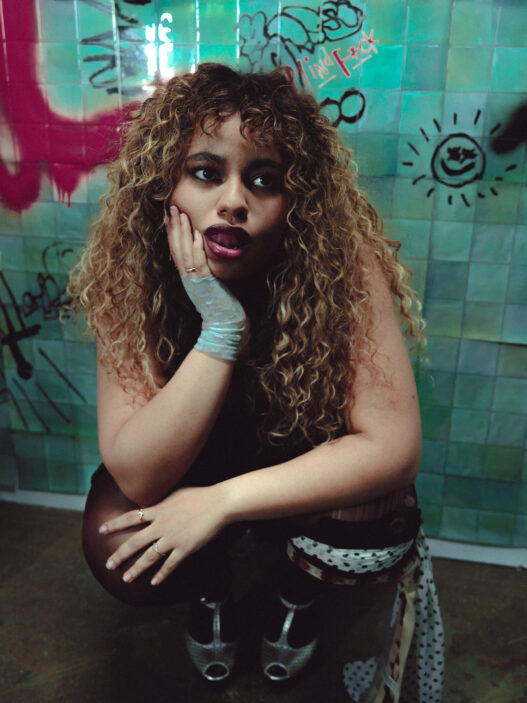



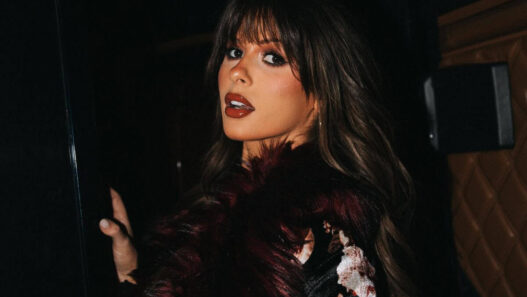





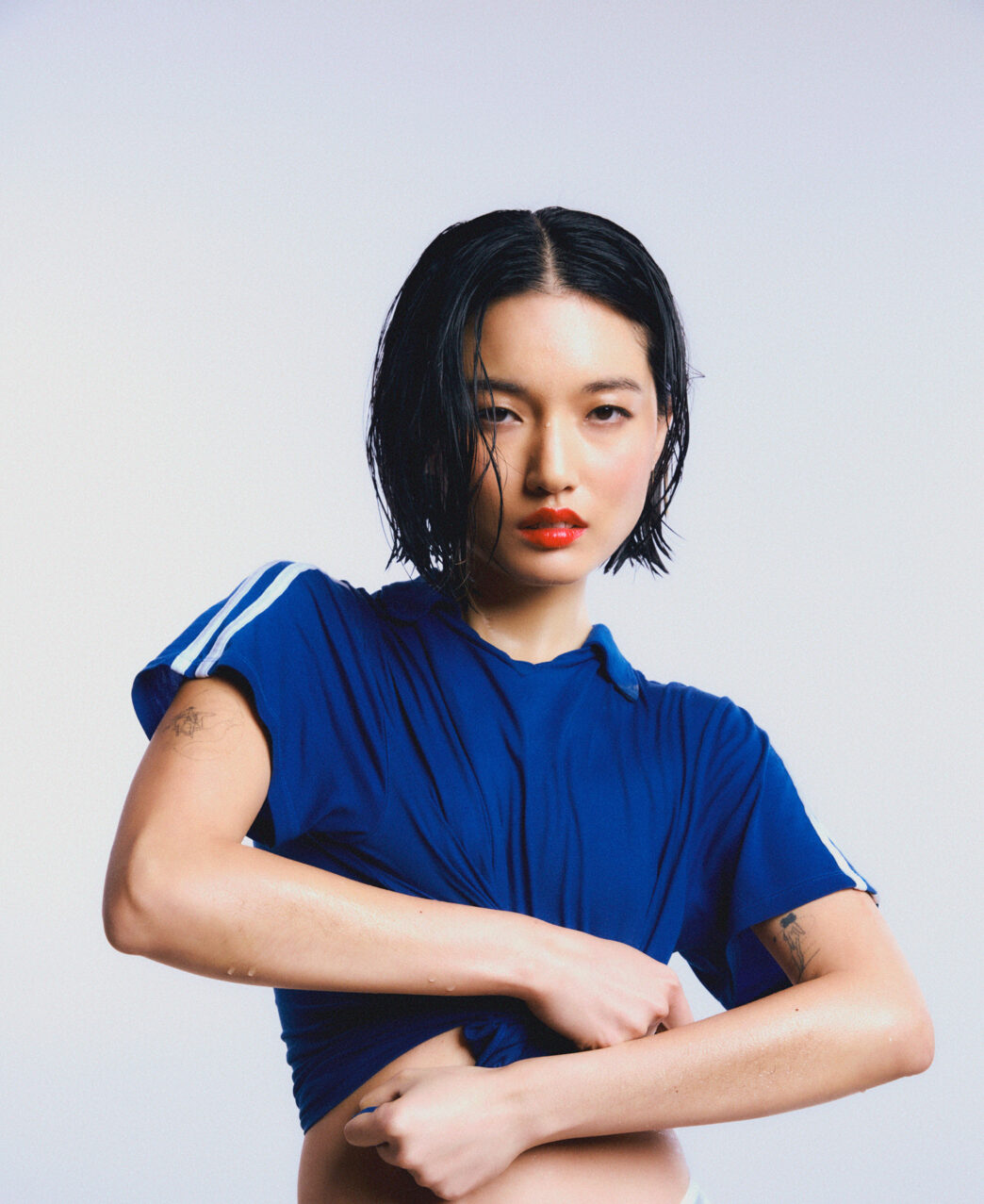
Chloe Qisha is in the driver’s seat of her brand. “You can just sayyyyyy maybe 6:30 to post, cause I’ll change the copy after this. I can’t fashion it right now,” she calmly told her manager regarding a social media post just before the start of this interview in New York City. The rising pop star, born in Malaysia and now based in London, was in town for her show at Brooklyn’s Baby’s All Right the night prior. “I loved the really camp disco wall of the back,” she said of the unmissable light fixture of the prominent Williamsburg venue.
Adamant of her love for “all things LGBTQ+,” her repertoire, which includes the forthcoming “21st Century Cool Girl,” the unpredictable and acidic “Evelyn,” and the glossy “So Sad, So Hot,” is unquestionably made for the girls and gays. “I have always been a pop girly through and through,” she said. “I grew up with Katy Perry’s Teenage Dream, and that was always my backbone of my catalog of listening. I’ve just welcomed every pop girly and pop boy.”
She hails the likes of Chappell Roan, Troye Sivan, and even Audrey Hobert, who she claims prompted her onstage movements, for keeping the spirit of pop alive in recent years. “It maybe felt like, in the late 2010’s, that it was a dying art,” she said. “Other than Beyoncé and Taylor Swift, people were going a bit off of the big pop girlies dominating.”
Her utterly irresistible pop and trop-house-leaning breakout hit “I Lied, I’m Sorry” begins with a spoken-word section reminiscent of Dry Cleaning, before shifting to one of the breeziest, most accessible hooks in recent memory. She sits comfortably within her mindful contralto wheelhouse, and says pop is not a competition between vocal styles or flavors. “We’ve always had examples of people speaking in their songs, which is really… REALLY… I was gonna say a bad word (it likely starts with a ‘c’), but that’s the nature of pop,” she affirmed. “You go where there is the most fun to be had. When you overthink things, that’s when it becomes inauthentic.”
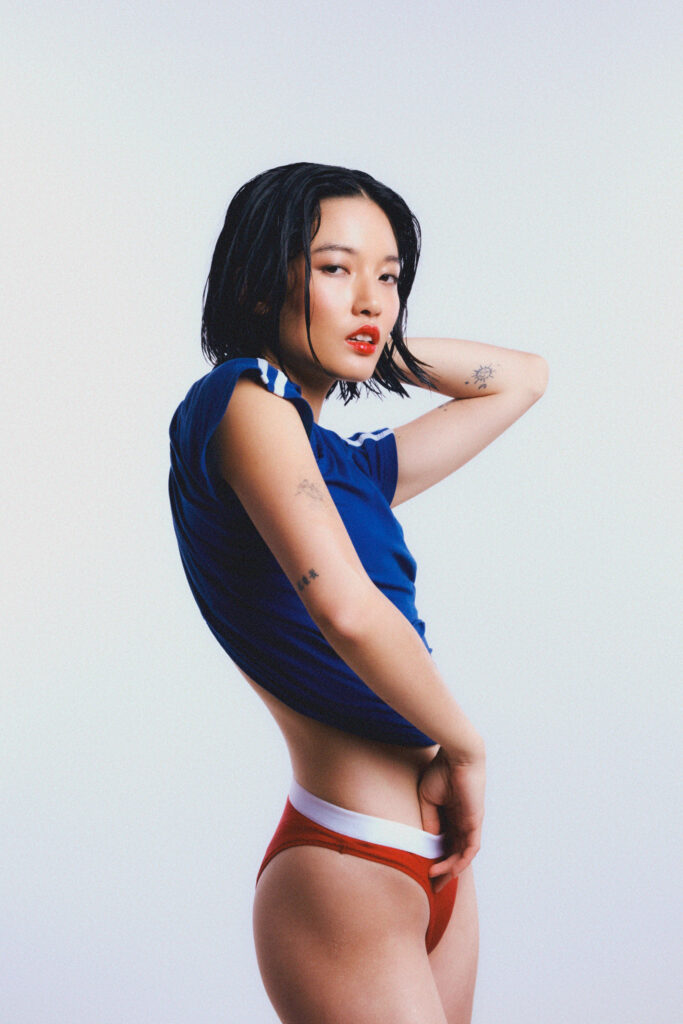
Last year, she scored a “joyous” gig opening for Coldplay at Wembley Stadium, as her music was said to have assisted Chris Martin amid a stage of depression, and “I Lied, I’m Sorry” was the recipient of a Kelly Clarkson cover on television. “In a world with such an oversaturated market, music you feel is good needs to be out in the world,” she said. “The hope is that it will find like-minded people. The Chris’ and the Kelly’s of the world are legends of the game because they love and create good music, and I’m so grateful my music has found its way to them.”
Influenced by the ambitious perfection of Rosaliá’s LUX, as well as the actuality of Holly Humberstone’s recent release “To Love Somebody,” Qisha’s current work is pushing the envelope. She proudly describes her synth-heavy single “YDH,” short for ‘Young, Dumb, and Horny,’ as “romantic BDSM,” singing, “It’s so hypnotic, hypnotic/ The way he moves his body, his body/ The way he’s got me pining and climbing the walls of my flat/ Clutching my peals at the thought of his abs.” Appearing in regal attire in its accompanying top dollar music video, Qisha leans into both the comically ludicrous and the foundational.
Though she leaves the onstage theatrics to that of her virtuous live crew, her sonic and visual aesthetics are her own doing. “I need a visual anchor to be able to create, release the music, and market it after,” she explained. “It’s about world building as opposed to releasing tracks to the ether and seeing what happens, which, again, is a valid way to do things.”
An unreleased effort called “He Likes Boys,” teased during recent live performances, can also be categorized into this daring new stage. “It was shelved for a bit, because I couldn’t make up my mind about how I was reacting to it,” she admitted. “It’s about unrequited love. A tale as old as time, not often talked about in songs or in literature, of when sexualities don’t quite match up. Of falling for your straight friends. It works vice versa. So many of my girl friends, on a night out, would really crush on a guy and then find out they’re gay, then months later they are best friends. It’s a very lived experience of a lot of people.”
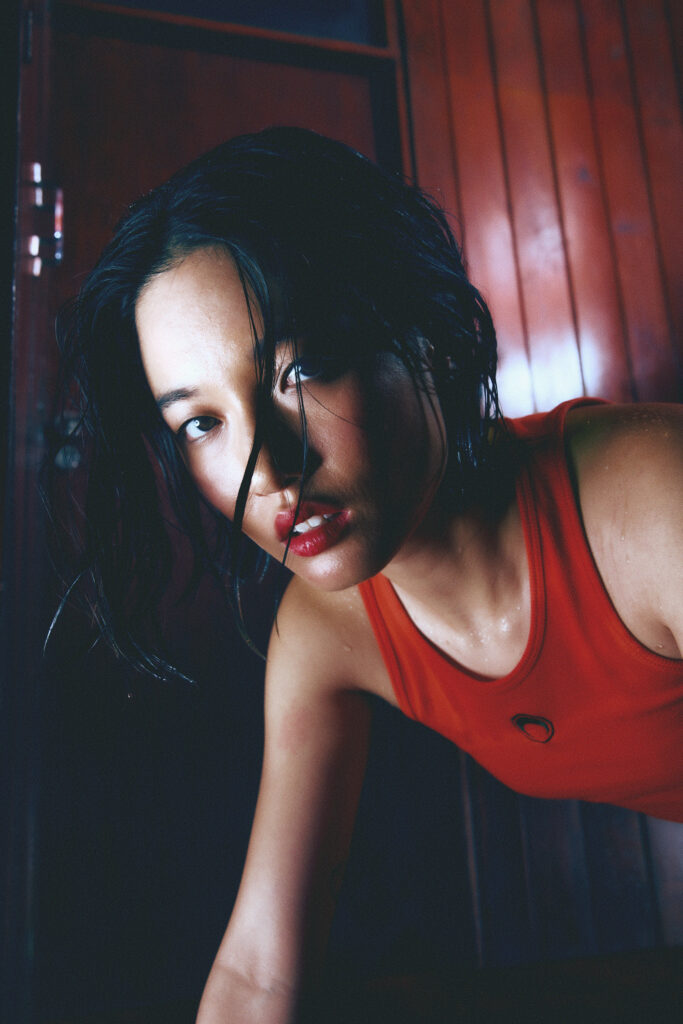
Despite these forward-thinking, libidinous creations, much of Qisha’s material delves into personal anecdotes from her younger years. Through telling these stories, even the negative experiences translate to lessons learned and/or the permission to grant oneself grace. “Maturing is accepting who you were when you were younger, even the embarrassing, cringey parts of yourself,” she said. “I look back on heartbreak from when I was, like, 16, and I laugh at it now. ‘You were cute and pathetic, but I love you for that.’ It’s about twisting the story and having fun in retrospect.”
Her advice to those currently in that cumbersome stage, or looking to evolve past it, is simple yet direct. “Don’t be afraid to let time take its course,” she said. “I came to music later on than most artists generally do, because I was young and dealing with a lot of insecurities. I only became this solid and confident and my mid-20’s.”
As she continues to develop her platform, voice her beliefs, and prosper as an artist, her catalog grows in both numbers and in substance. “I’ve been really busy writing and figuring out where the world is with this, and I feel like I have a collection now of at least 10-12 songs that have written a story,” she said. “Whether it becomes an album, EP, or mixtape, it’s cohesive, and that’s the main thing.”
Her latest single, “Suprise, Suprise,” released today.