














Rapper and entrepreneur Gilbert “Berner” Milam Jr has put $2 million of his own money into Splash City, a crime drama intended to show audiences a side of his San Francisco hometown that the movies rarely capture.
For Berner, that kind of self-financing is less improbable than it might initially sound. Alongside a rap career, he is the co-founder and CEO of Cookies, the San Francisco-based cannabis company that has expanded to more than 70 retail locations across six countries. Berner has also founded the Cookies SF streetwear brand. That independence has shaped the way he approaches filmmaking, too. The San Francisco-born Berner has spent years telling stories through his music, but film has given him something a three or four minute song cannot; time.
“I feel like this is a much better way to tell a story at length, as well as connecting a visual to what you’re saying,” he told me. “In music, you do a music video, but then it’s kind of short lived. It kind of comes and goes, people’s attention spans are kind of all over the place. But with the film, you can kind of tell your story and you can visualize it at the same time.”
Perhaps that is why the move into filmmaking feels less like a departure than an extension of what Berner has already been doing. Hip hop artists moving into Hollywood is nothing new, but Berner is not particularly interested in simply appearing on screen. “I’m a writer, I like to write, I write music, I just wrote a book. I’m a storyteller,” he said. “For me, it’s important for me to kind of elevate my storytelling through film.”

Splash City tells the story of brothers Juju and Slim. While they experience the same environment, they end up heading in two very different directions. At the centre of the film is a question about how much the people around someone can determine where their life goes. “I want to kind of show that even if you have a good role model like Slim and you have a good mother and you have a solid home, the influence from your entourage and your friends could lead where you’re going to go in life,” Berner explained. “I think we see that so much, especially in my world, that people just are good people with great hearts, but they’re surrounded by the wrong things.”
Berner’s filmmaking ambitions have been shaped in part by crime dramas such as American Me, Blood In Blood Out, Casino, Goodfellas, The Usual Suspects and Heat. But Juice and New Jersey Drive became particularly important reference points for Splash City. He was drawn to the way those films immersed audiences in places and experiences they might otherwise never encounter. “I didn’t even know what New Jersey was until I saw the movie,” he said of New Jersey Drive. For Berner, Splash City offered a chance to do the same for the San Francisco he grew up in. “We have our great crime stories as well. You have Boston, Baltimore, New York, LA, Chicago, they’ve all done their stories, but we’ve never had a chance to do ours.”
Berner brought another distinctly Bay Area element to Splash City through the music, drawing on his own background as a rapper to help establish the film’s atmosphere. He describes the region’s musical identity as “very mobby, dark, kind of gritty,” a feeling he wanted reflected in the film’s look and sound. “The way we colored it, the way we shot it, the angles we got, the vibe of the film and the music really kind of helped shape the film,” he said.
That local perspective also shapes the way Berner portrays the relationships between his characters. In one scene Dolo, the villain of Splash City, played by Quincy Brooks, approaches Juju played by Reed Shannon at a basketball court under the guise of trying to mentor him, but Berner intended the interaction to carry a more threatening undertone. He described it as a “slimy kind of backdoor, hidden agenda vibe” – the sort of influence that can appear harmless before quietly redirecting someone’s life.
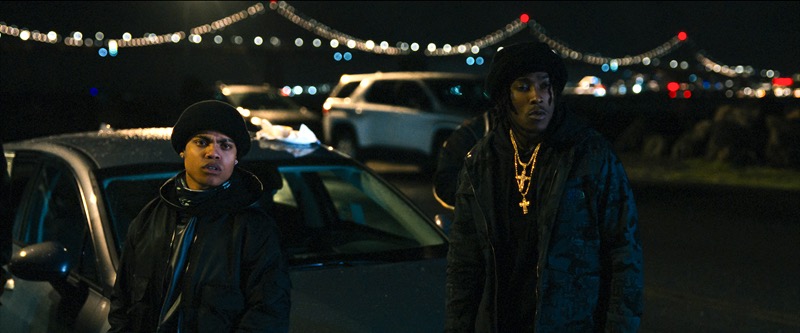
Berner said he was less concerned with whether Splash City might glamorize street life than with making sure the consequences were embedded in the story. He pointed to films such as Scarface, Goodfellas, Casino and Heat, arguing that crime movies have long made dangerous worlds compelling to watch. What mattered to him was where those choices led to. “there’s a very hidden message that shows like, look, something small could turn into something big. And your friends are not who you think they are. Being around the wrong people will lead to something super, super, super bad.”
Berner’s desire to maintain control over the story also shaped how the film was financed. Rather than wait for the traditional Hollywood system to finance his first film, Berner decided to fund it himself. “I was like, I’m just gonna go ahead and write this and film it. And I put my money up.” But making a film independently also meant taking on the financial risk himself. Splash City was originally supposed to cost around $500,000. That figure did not last very long. “Within the first day they hit that budget up,” he said. “And I said we need more, then we need more. And it kept going until I hit $2 million. And that’s when I was like, yeah, this is not what I expected.”
The escalating cost left him personally financing a film without knowing exactly what would happen to it afterward. The decision to finance the project itself is closely connected to the way Berner has built his career outside traditional systems. He admits that putting $2 million into a film without knowing exactly what would happen to it was “a very stressful situation.” It was only after making the film that Berner found a studio partner. Lionsgate ultimately came aboard to distribute Splash City, giving the independently financed project a route to a wider audience.
When I asked what happens after Splash City, Berner revealed that filmmaking has not changed how he listens to music, but it has changed how he thinks about making it. “I hope to elevate to being a filmmaker that still makes music,” he said. “When I make music in the future, I hope to make original soundtracks and original music for films and scoring films.” Five years from now, Berner hopes to be on his second or third film and is trying to move closer to that goal. After years spent building businesses, releasing music and now making films, his ideal future sounds surprisingly simple: “I’d like to be writing movies in Hawaii.”
However, beneath the business plans and ambitions is something larger. Berner has spoken increasingly about legacy, and what he wants to leave behind. “To live forever through your work, or as long as you can through your work,” he said, when I asked what legacy means to him now. “There’s certain people that leave, and leave a mark here on earth. And that’s my goal.” For Berner, that includes his children, his companies, his products, his music and now his films. “When people see my children, like, ‘Oh, that’s Berner’s kids, you know, he did this, or he did that.’ Like, when people see my products, or they see my company, or they see something, I want to be able to live through my work.”
Perhaps Splash City is ultimately part of that same idea. Berner wants audiences to see San Francisco as more than the city they already think they know. He wants its crime stories, language, music and people to become part of its cinematic identity too. “It’s a beautiful city. It deserves to be on film a lot more.” Perhaps that is the simplest explanation for why Berner made Splash City. San Francisco has appeared on screen countless times. He just wants people to see his version of it.
SPLASH CITY released On Digital and VOD Friday September 4th.